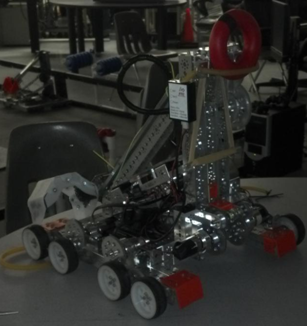
This serves two ever-useful functions: first, it gives us a place to put our sponsor(s) logo(s); second, it gives us a shield to prevent other robots from damaging our robot's insides; third, now we can put Sonic on Sonic.
12.10.2012
Shields Up!
In light of our recent acquisition of sponsors – as well as the need to display our team number – we plan to construct a frame for our robot, where we'll mount two big sheets of plexiglass.
12.07.2012
Autonomous Ring
In the interest of speed and efficiency, we decided to create a separate holder for the autonomous ring. This holder allows three things to be accomplished: simpler coding, placement of the ring, and ideal positioning. The slight advantage this gives may not seem like much, but it adds up.
12.06.2012
Improving the End Effector
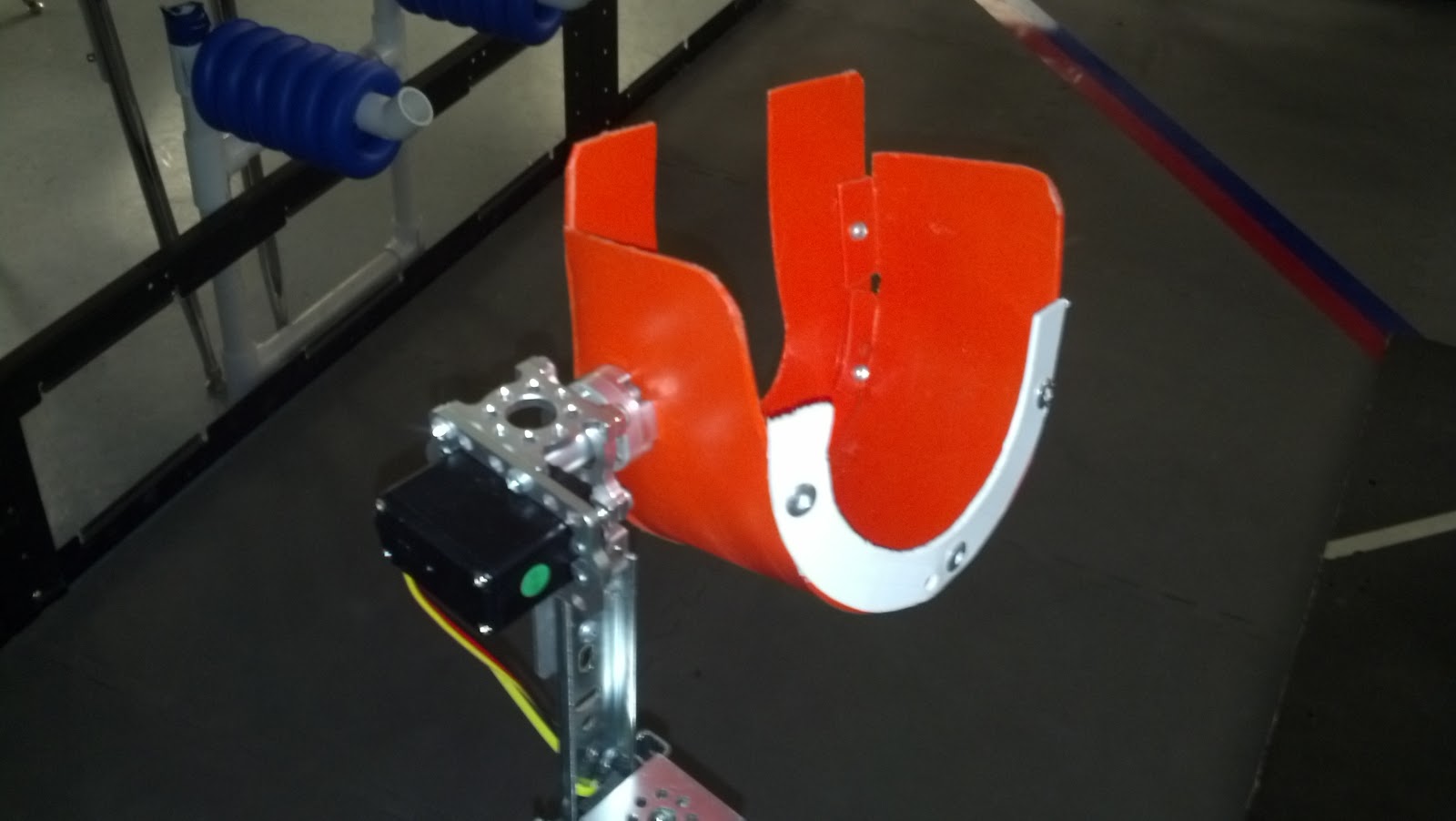
The old end effector design, while good, was not as efficient as we wanted – it worked beautifully, but being the perfectionists that we are, we wanted to do even better. We decided to slightly alter the shape of the end effector, which should allow it to secure the rings even better.
It is still a prototype, but the results so far have been promising.
Casey's New Toy
Today, we finally got the shipment of IR Sensors that we'd been waiting for, and the team is rightfully excited. Unfortunately, the only thing standing in the way of Casey and his new toy was the mandatory prototyping we do before sticking it on. So in lieu of being hounded to death by the general populace, I quickly drew us a simple mount for the sensor. It's not pretty, but it gets Casey off my case and onto the computer, so I call that a win!
11.30.2012
The Finger Muncher Mk. II
Our lift system for the arm worked beautifully, but we soon realized that we had not allowed enough room in the upper portion of the tower for the arm, which ultimately resulted in the tower and axle getting warped. As our arm had screws and brushing on it, it was actually wider than the gap provided by the two support channels, making them bend apart and bend our axle. We began brainstorming on methods of preventing this, such as supporting the channels to prevent bending or moving each channel a spot over. We finally decided on using two supports connected to a single support with flat brackets in the middle, which provided a sufficient enough space to allow the arm full rotation without any bending. At the same time we edited the lift system and moved the spool outward to allow for easier access and maintenance. The result is the Finger Muncher Mk. II – a beautifully efficient arm and lift system that will happily devour any finger that gets a little too close to it.
11.26.2012
Base Instincts
As the channel the motors are mounted on would bend while moving the lift up or down, we attached a second channel next to it that mounts one channel to another, preventing bending or rotation. This makes the motor mounts much stronger and gives the axle less give to slide.
11.21.2012
Coming Together
For the first time in a long while, Sonic is once again ready for testing. We fixed the string system for raising and lowering the lift and moved it so it is easily accessible if it needs to be changed or repaired. While practising with the robot, we noticed that the axle holding the strings would slide, allowing the gears to lose contact with each other. By providing more stabilization to the motor mounts and adjusting the axle, we hope to prevent this from occurring.
11.20.2012
String Theory
What is touchy, fragile, and impossible to maintain? Our string spool, apparently. Whenever our robot decides to break its string – which it does more often then we'd like – it becomes a full day's chore to replace it. A few cramped hands later, we decided we needed a new one. So, as usual, it's back to SolidWorks for prototyping. The new one will move the whole spool assembly out to the back of the robot, making it a lot more accessible and – hopefully – easier to repair.
Subscribe to:
Posts (Atom)